
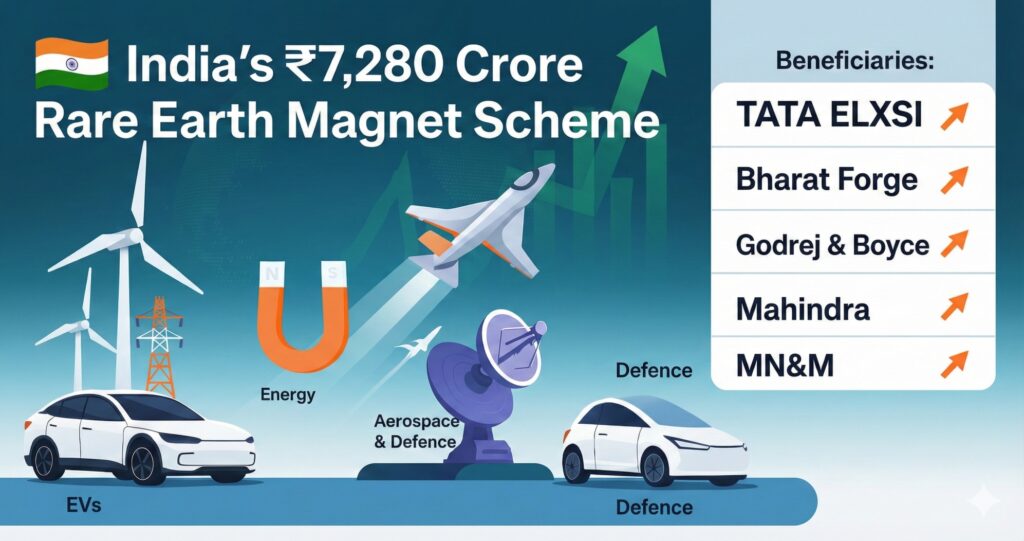

On 26 November 2025, the Union Cabinet approved a ₹7,280 crore scheme to promote manufacturing of sintered Rare Earth Permanent Magnets (REPM) in India3. This is a first-of-its-kind initiative aimed at reducing import dependence, strengthening supply chains, and positioning India as a global leader in advanced manufacturing.
But beyond policy, investors are asking: Which stocks stand to benefit? Let’s break it down.
🔑 Scheme Highlights
- Financial Outlay: ₹7,280 crore
- Production Capacity: Target of 6,000 MTPA of REPM
- Beneficiaries: Five companies selected via global competitive bidding
- Incentives:
- ₹6,450 crore in sales-linked incentives (over 5 years)
- ₹750 crore as capital subsidy
- Timeline: Valid for 7 years, including a 2-year gestation period2
📈 Stocks Likely to Benefit
| Sector | Stock | Why It Benefits |
|---|---|---|
| Electric Vehicles (EVs) | Tata Motors, Mahindra & Mahindra | REPMs are critical for EV motors; domestic supply lowers costs and accelerates adoption. |
| Defence & Aerospace | Bharat Electronics (BEL), Hindustan Aeronautics (HAL) | Magnets are vital for precision systems, radars, and aerospace equipment. |
| Renewable Energy | Tata Power, Suzlon Energy | Wind turbines rely heavily on REPMs; local manufacturing boosts margins. |
| Electronics | Dixon Technologies, Havells | Consumer electronics and appliances use REPMs in motors and sensors. |
| Mining & Materials | NMDC, Vedanta | Potential upstream role in rare earth extraction and supply chain integration. |
Sources: 2
🌍 Why This Matters
- Strategic Independence: Cuts reliance on Chinese imports.
- Green Energy Transition: Supports India’s Net Zero 2070 goals.
- Investor Opportunity: Creates a new growth story in EVs, defence, and renewables.
FAQs (Rare Earth Magnet Boom: Cabinet Clears ₹7,280 Cr Scheme
Q1: Which stocks benefit from India’s rare earth magnet scheme? Tata Motors, Mahindra & Mahindra, BEL, HAL, Tata Power, Suzlon, Dixon, NMDC, Vedanta.
Q2: Why are rare earth magnets important? They power EV motors, wind turbines, aerospace systems, and advanced electronics.
Q3: How long will the scheme run? Seven years, including a two-year gestation period.