
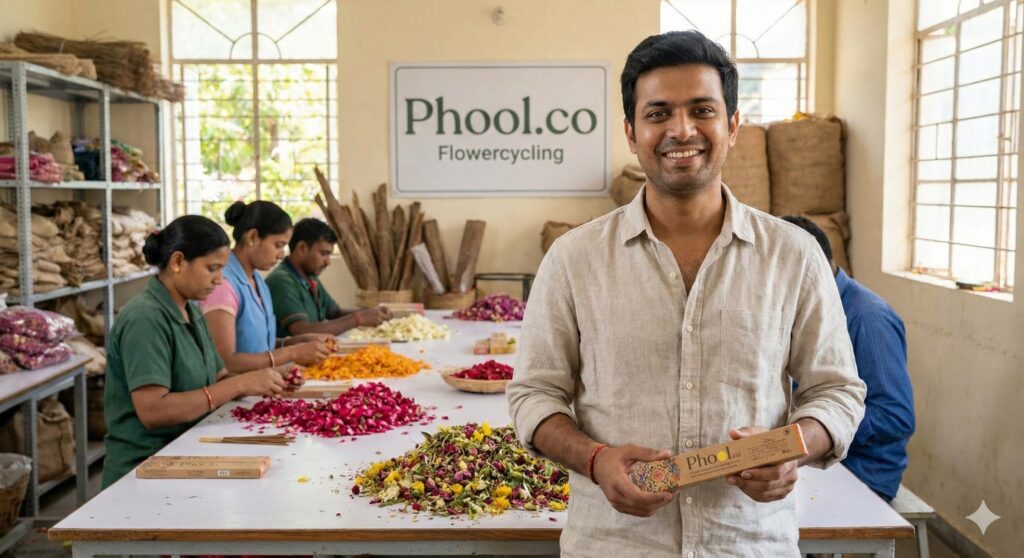

Every morning, millions of flowers are offered at temples across India as symbols of devotion. But what happens after the prayers end? For decades, these sacred offerings ended up polluting rivers like the Ganga. In 2017, Ankit Agarwal and Prateek Kumar from Kanpur saw this problem and turned it into an opportunity. Their startup, Phool.co, became India’s first company to recycle temple flowers into eco‑friendly products
Founder Background
Ankit Agarwal, a Kanpur‑born engineer, was deeply disturbed by the sight of marigolds and roses floating in polluted waters. His philosophy was simple: “Waste is not the end, it’s the beginning of something new.” Together with Prateek Kumar, he envisioned a circular economy where devotion wouldn’t harm the environment
Startup Journey & Timeline
- 2017: Founded in Kanpur as Kanpur Flowercycling Pvt. Ltd.
- 2018–2019: Developed incense sticks and compost from recycled flowers.
- 2020: Expanded operations, recycling over 11,000 metric tonnes of temple waste in four years.
- 2021–2023: Split into two entities — HelpUsGreen (social impact) and Phool.co (biomaterials innovation).
- 2025: Recognized globally as a pioneer in sustainable biomaterials
Innovation & Impact
Phool.co solves a unique environmental problem: temple flower waste. Instead of polluting rivers, flowers are transformed into:
- Incense cones & sticks (eco‑friendly, chemical‑free)
- Compost & fertilizers
- Biomaterials for packaging and leather alternatives
Impact:
- Reduced river pollution in Kanpur and beyond.
- Created jobs for women from marginalized communities.
- Positioned India as a leader in sustainable innovation1.
Business Model & Strategy
- Revenue Streams: Eco‑products (incense, compost), biomaterials, B2B partnerships.
- Customer Segments: Eco‑conscious consumers, temples, corporates.
- Differentiation: First‑mover advantage in flower recycling, strong sustainability branding.
Funding, Valuation & Growth
Phool.co has attracted attention from social impact investors and sustainability funds. While exact valuation figures are undisclosed, the startup has scaled rapidly, with recognition from UN Environment Programme and global sustainability awards1.
Challenges & Lessons Learned
- Scaling waste collection across thousands of temples.
- Convincing consumers to adopt eco‑products.
- Funding hurdles in early years.
Lesson for entrepreneurs: “Innovation is not about technology alone — it’s about solving real human problems.”
Future Vision
Phool.co aims to:
- Expand biomaterials research (eco‑leather, packaging).
- Scale operations to Tier 2–3 cities.
- Explore international markets for sustainable products.
Founder Ankit Agarwal envisions Phool as a global leader in biomaterials, proving that devotion and sustainability can coexist2.
Conclusion
The Indian startup story of Phool.co is a testament to how small observations can spark revolutions. From polluted rivers to eco‑friendly products, Phool has shown that entrepreneurship in India can be both profitable and purposeful.