
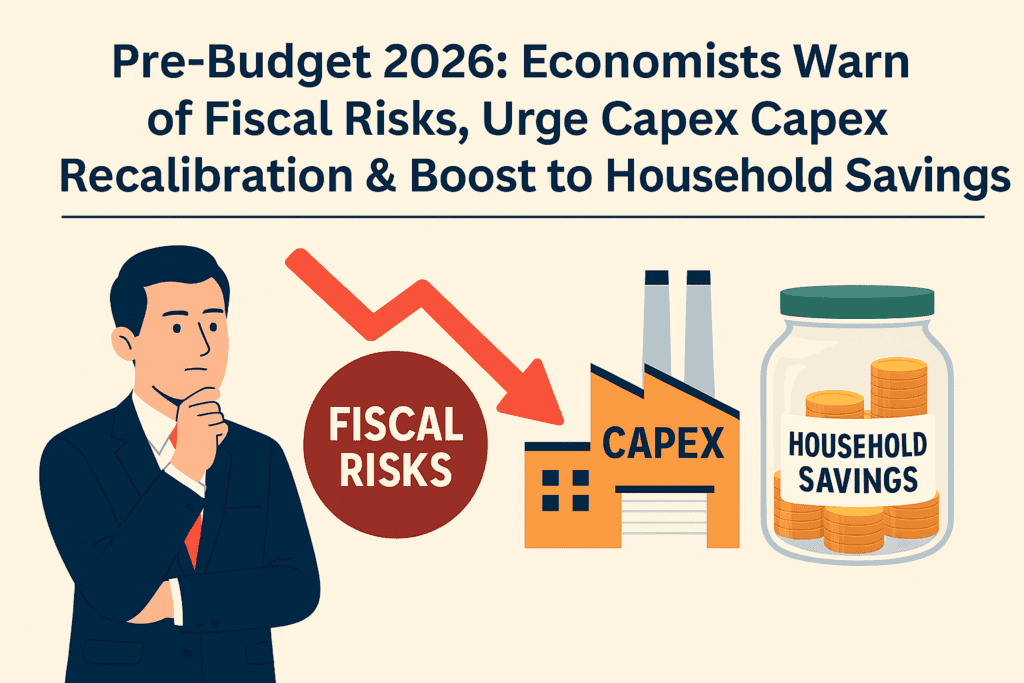

Ahead of pre-Budget 2026, economists warn of fiscal risks and urge recalibration of capital expenditure and revival of household savings. Explore key insights, policy signals, and growth outlook.
Budget 2026: Why This Year’s Pre-Budget Meet Matters
As India prepares for Union Budget 2026, the Prime Minister’s pre-budget consultation with economists has spotlighted three critical themes:
- Mounting fiscal risks amid global uncertainty
- Need for smarter capital expenditure (capex) allocation
- Urgent revival of household savings to support long-term growth
With Finance Minister Nirmala Sitharaman set to present the budget on February 1, 2026, the stakes are high. The meeting comes against the backdrop of geopolitical tensions, a 50% US tariff on Indian exports, and sluggish household savings rates, which have dipped below 20% of GDP for the first time in a decade.
📊 Key Takeaways from the Pre-Budget 2026 Consultations
1. ⚠️ Fiscal Risks & Revenue Pressure
Economists flagged concerns over rising revenue expenditure, subdued nominal GDP growth, and pressure on gross tax revenues (GTR).
- The fiscal deficit target of 5.1% may be hard to meet without trimming subsidies or boosting tax compliance.
- Experts urged a reduction in non-essential spending and better targeting of welfare schemes.
2. 🏗️ Capex Recalibration
While public capex remains a growth engine, economists recommended:
- Shifting focus from quantity to quality of investment
- Prioritizing infrastructure projects with high multiplier effects
- Accelerating clearances under PM Gati Shakti and resolving PPP disputes
3. 💰 Household Savings Revival
India’s household savings rate has declined due to inflation and rising consumption.
- Economists called for tax incentives on long-term savings instruments
- Suggested revamping small savings schemes to attract retail investors
- Emphasized the role of financial literacy and digital inclusion
🌐 Economic Outlook for FY27
Despite fiscal challenges, India’s growth story remains resilient:
- ADB and RBI project FY27 GDP growth at 7.2–7.3%
- Private investment sentiment is improving, thanks to easing inflation and cumulative RBI rate cuts
- Corporate bond market reforms and credit access for MSMEs are expected to support capex momentum
🧠 Expert Voices
“The government must balance fiscal prudence with growth imperatives. Quality capex and household savings revival are key to sustaining momentum.”
— Madan Sabnavis, Chief Economist, Bank of Baroda
“We need to crowd in private investment by unlocking stalled assets and improving dispute resolution frameworks.”
— ASSOCHAM Pre-Budget Note
📌 Final Thoughts: What to Watch Ahead of Budget 2026
As Budget Day nears, investors, policymakers, and citizens should track:
- Capex allocations across transport, energy, and logistics
- Announcements on savings schemes and tax slabs
- Signals on fiscal consolidation and deficit targets
The Union Budget 2026 is not just a financial document—it’s a roadmap for India’s medium-term growth. With economists urging recalibration, the government’s response will shape sentiment across markets, households, and global observers.
🧠 FAQs (People Also Ask)
Q1. What are fiscal risks in Budget 2026?
Rising revenue expenditure, subdued tax collections, and global trade disruptions pose fiscal risks.
Q2. Why is capex recalibration important?
To ensure public investment delivers high returns and avoids inefficient spending.
Q3. How can household savings be revived?
Through tax incentives, better savings schemes, and financial literacy drives.