
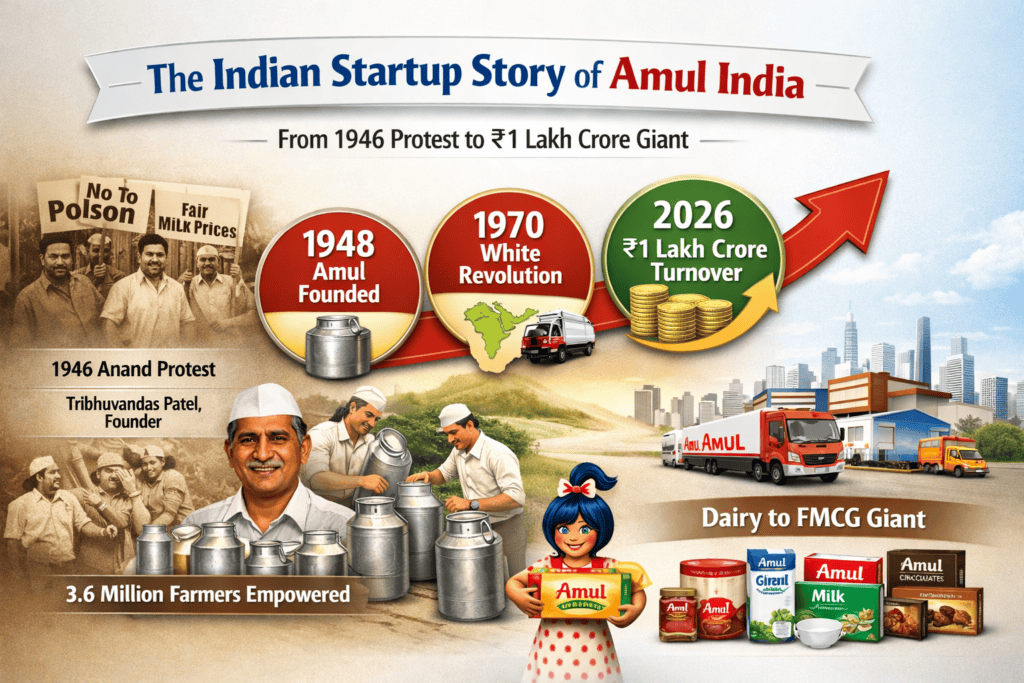

Amul’s Indian startup story is one of resilience, farmer empowerment, and cooperative innovation—transforming a small protest in Anand, Gujarat in 1946 into a ₹1 lakh crore FMCG powerhouse today. This journey exemplifies how grassroots entrepreneurship can reshape an entire industry and inspire India’s startup ecosystem.
Introduction
In 1946, a group of farmers in Anand, Gujarat, led by Tribhuvandas Patel and inspired by Sardar Vallabhbhai Patel, refused to bow to exploitative milk cartels. What began as a protest soon became Amul India, a cooperative movement that redefined dairy entrepreneurship in India. Today, Amul is not just a brand—it’s a symbol of trust, empowerment, and innovation in the Indian startup ecosystem.
👤 Founder Background
- Tribhuvandas Patel, a visionary leader, spearheaded the cooperative model.
- Inspired by Sardar Patel’s call for self-reliance, he mobilized farmers to take control of their produce.
- Early struggles included lack of infrastructure and resistance from entrenched cartels.
- Patel’s vision: “True entrepreneurship is about empowering the weakest link in the chain.”
🚀 Startup Journey & Timeline
- 1946: Farmers’ protest against Polson Dairy cartel.
- 1948: Formation of Anand Milk Union Limited (Amul).
- 1950s: Expansion into butter, milk powder, and cheese.
- 1970: Launch of Operation Flood, India’s “White Revolution.”
- 2000s–2020s: Diversification into ice cream, chocolates, beverages.
- 2026: Crossed ₹1 lakh crore turnover milestone.
💡 Innovation & Impact
- Solved milk cartel exploitation through cooperative ownership.
- Built a three-tier system: village societies → district unions → state federation.
- Impact:
- Empowered 3.6 million farmers.
- Expanded reach into Tier-2 & Tier-3 cities.
- Created thousands of jobs across India.
💰 Business Model
- Revenue Streams:
- Dairy products (milk, butter, cheese, ice cream).
- Value-added FMCG (chocolates, beverages).
- Customer Segments: Urban & rural households, institutional buyers.
- Market Size: India’s dairy market worth ₹13 trillion.
- Competitive Advantage: Cooperative trust, brand recall, wide distribution.
📊 Funding & Valuation
- Cooperative model—funded by farmers, supported by government initiatives.
- Valuation: Over ₹1 lakh crore turnover in FY26.
- Key investors: Farmers themselves—the true stakeholders.
⚠️ Challenges & Lessons
- Struggles with scaling supply chain.
- Competition from private FMCG giants.
- Lesson: Trust + consistency = brand longevity.
🔮 Future Vision
- Expansion into plant-based dairy alternatives.
- Global exports to Asia & Africa.
- Potential IPO of cooperative subsidiaries.
- Continued mission: “Empower farmers, feed the nation.”
📈 Indian Startup Ecosystem Context
Amul’s story is a template for Indian startups:
- Grassroots entrepreneurship → national impact.
- Fits into India’s unicorn ecosystem as a cooperative giant.
- Supported by government dairy initiatives and digital supply chains.
⭐ Key Takeaways
- Farmer-led entrepreneurship can scale into billion-dollar enterprises.
- Cooperative trust beats corporate exploitation.
- Innovation + inclusivity = sustainable growth.
❓ FAQs
- What does Amul India do? – Dairy & FMCG cooperative.
- Who founded Amul? – Tribhuvandas Patel, inspired by Sardar Patel.
- When was Amul founded? – 1946 in Anand, Gujarat.
- Funding details? – Cooperative model, farmer-owned.
- Revenue model? – Dairy + FMCG products.
- Growth journey? – From protest to ₹1 lakh crore turnover.
🔗 Internal Linking Suggestions
- The Lahori Zeera Journeyhttps://smartinvestingtip.in/lahori-zeera-indias-startup-story/
- Razorpay: The Indian Startup Storyhttps://smartinvestingtip.in/razorpay-the-indian-startup-story-that-revo/