
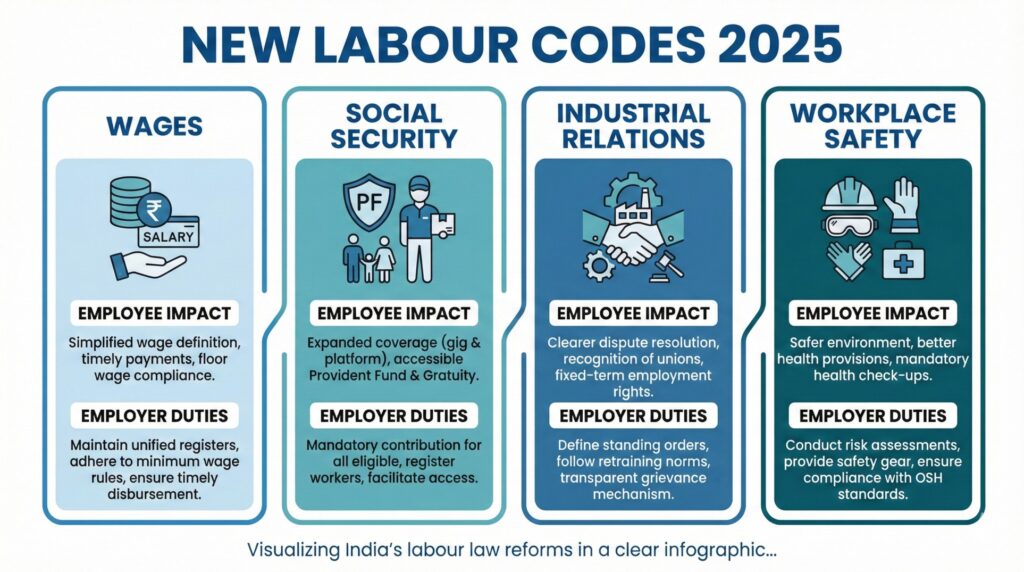

India’s labour law landscape has undergone a historic transformation. On November 21, 2025, the government implemented four new Labour Codes that replace 29 outdated laws with a streamlined, worker-centric framework. Whether you’re an HR professional, gig worker, salaried employee, or business owner, these changes affect how you earn, hire, and comply. This post breaks down the reforms in a clear, engaging, and authoritative way.
⚖️ What Are the Four New Labour Codes?
| Code Name | Key Focus |
|---|---|
| Code on Wages, 2019 | Uniform wage definition, minimum wage, timely payment |
| Code on Social Security, 2020 | PF, ESI, maternity benefits, gig worker inclusion |
| Industrial Relations Code, 2020 | Hiring, firing, strikes, dispute resolution |
| Occupational Safety, Health & Working Conditions Code, 2020 | Workplace safety, working hours, welfare provisions |
Sources: 2
💼 Key Changes You Should Know
- Basic Salary must be ≥ 50% of CTC – This impacts PF, gratuity, and take-home pay
- Gig and platform workers now covered – Social security benefits extended to freelancers and app-based workers
- Work-from-home legalized – Especially for women and disabled workers
- Equal pay and anti-discrimination – Gender and identity-based bias is now explicitly banned
- Simplified compliance – One registration, one return, one license for multiple laws
👩💼 Impact on Employees & Employers
For Employees:
- Higher PF and gratuity contributions
- More transparency in salary structure
- Legal protection for gig and remote workers
- Safer and more inclusive workplaces
For Employers:
- Restructuring of salary components
- Unified compliance portal
- Clearer rules for hiring, firing, and dispute resolution
- Penalties for non-compliance are stricter
👩⚖️ Expert View: Labour Laws 2025
1. Structural Reform
Labour law experts highlight that the consolidation of 29 laws into 4 codes is not just administrative—it’s a structural reset. By simplifying compliance into “one registration, one return, one license,” India is aligning with global best practices, making it easier for businesses to operate while ensuring workers’ rights are protected.
2. Impact on Salaries
Chartered accountants and HR consultants note that the 50% Basic Salary rule will reshape compensation structures. While employees may see reduced take-home pay due to higher PF and gratuity contributions, experts argue this strengthens long-term financial security.
3. Gig Economy Recognition
Labour economists emphasize that including gig and platform workers under social security is a landmark move. India is among the first major economies to formally recognize app-based workers (delivery, ride-hailing, freelancing) as part of the labour force deserving benefits.
4. Workplace Inclusivity
Legal scholars point out that provisions for work-from-home, equal pay, and anti-discrimination are progressive steps. They align with international conventions and respond to post-pandemic realities, ensuring inclusivity for women, disabled workers, and diverse identities.
5. Compliance Challenges
Industry bodies caution that while the codes simplify processes, implementation remains complex. Smaller firms may struggle with restructuring salary components and adapting to stricter penalties. Experts recommend phased adoption and government-led awareness campaigns.
❓ FAQs on Labour Laws 2025
Q1. Are these laws applicable to all sectors?
Yes, they apply to formal, informal, gig, and platform workers across industries.
Q2. Will my take-home salary reduce?
Possibly. With Basic Salary ≥ 50% of CTC, PF and gratuity deductions may increase.
Q3. How do I check if my employer is compliant?
Use the Shram Suvidha Portal to verify registration and filings.
Key Takeaway from Experts
The consensus is clear: Labour Codes 2025 are a balancing act — protecting workers’ rights while modernizing India’s labour market. Employees gain stronger social security and inclusivity, while employers face both opportunities (simplified compliance) and challenges (higher costs, restructuring).